Skip to content

what is RFID?

It is a unique, automated identification technology that uses electromagnetic waves transmitted through the air to remotely identify living beings and objects—whether stationary or in motion. The term RFID stands for Radio Frequency Identification.

In practice, it is used to identify any product by assigning it a unique electronic identity. In this way, RFID acts as a bridge between the physical and digital worlds, giving a unique identity to objects or living beings and enabling interconnection between objects, people, and services—forming the foundation of the Internet of Things (IoT).

RFID technology, and applications in logistics.

TAG: What is it. - RFID labels.

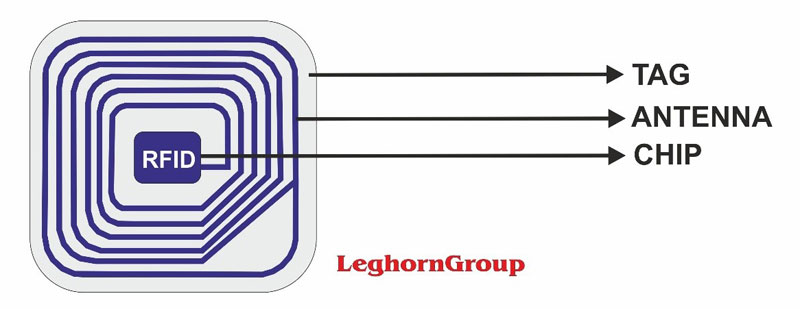
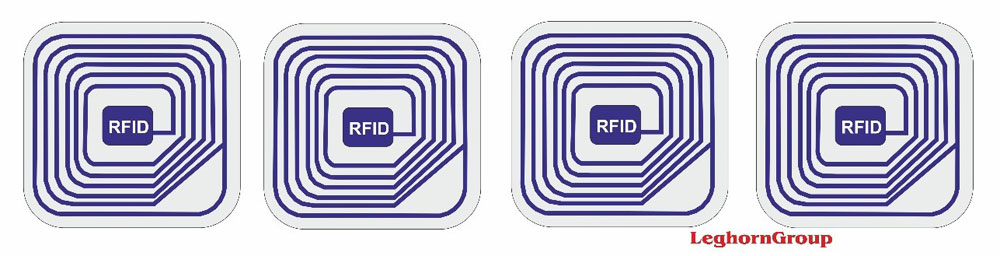
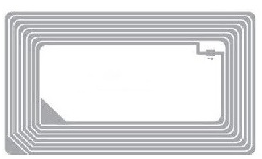
An RFID tag is a simple self-identification device equipped with a microchip and an antenna.
This electronic label (TAG) is designed to store and transmit data without requiring physical contact.
It also enables precise, unambiguous tracking of individual products, as each RFID tag is unique and cannot be duplicated.

RFID technology in logistics

Basic components of an RFID tag are:

  1. Microchip
    • This component contains the label-specific data.
    • It can store information such as unique codes, product handling, production data, storage point.
  2. Antenna
    • The antenna wirelessly transmits data contained in the microchip.
    • It allows two-way communication, when activated by a radio frequency signal emitted by an RFID reader.
  3. Support
    • Normally it is a label made of adhesive paper, or plastic.

Types of TAGs:

Passive TAGS

  • They have no energy of their own
  • Short reading distance
  • Inability to integrate auxiliary
    sensors

LOW COST TAG

Semi-passive TAGS

  • They are helped to “awaken” thanks to their own
    energy
  • Long reading distance
  • Can integrate auxiliary sensors

MEDIUM COST

Active TAGS

  • They have their own energy
  • Long reading distance
  • Can integrate auxiliary
    sensors

HIGH COST

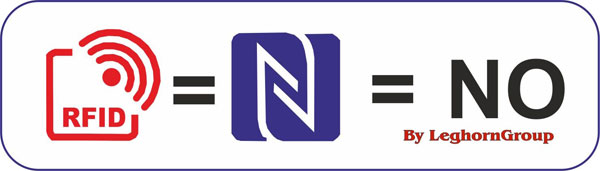
Is RFID the same as NFC?
RFID Technology, And Applications In Logistics.

The answer is NO!

NFC is a subset of RFID technology and offers more limited capabilities compared to RFID.
It operates at very short distances—up to 10 cm—beyond which communication with the reader is not possible.
NFC also enables two-way communication between the reader and the NFC tag.
Here are the key differences between RFID tags and NFC.

Charecteristics Tag RFID Tag NFC
Reading distance Reading distance is from 20cm to over 10 meters Max reading distance 10 cm
Device support Needs an RFID reader to read an RFID tag Can be read by smartphones and other NFC-enabled devices
Communication Send One-Way Information Two-way communication: can send and share information
Velocity Multiple tags can be read at the same time NFC Only one tag can be read at a time
Data Store Carry ID information only Can store and transmit multiple types of data
Cost More expensive given its longer read range NFC Cheaper given shorter read range

Here are the different fundamental characteristics between RFID and barcode

RFID technology, and applications in logistics.
RFID Technology, And Applications In Logistics.
Charecteristics RFID Barcode
Effectiveness Multiple RFID tags are read simultaneously (up to 200/sec) and no line of sight is required for reading One code is read at a time and a line of sight is required between the code and the scanner to read
Resistance Tags can be very durable. It is not susceptible to agents that prevent it from being read. Labels are easily damaged. Dirt and other agents can prevent them from being read
Capacity They are equipped with internal memory and can be associated with a large amount of data. A very limited amount of data can be assigned to it.
Flexibility The data on the tags can be both read and written. The tags are reusable and allow dynamic access to information. The information is static. Not modifiable.
Other advantages of RFID over barcode: Compared to barcodes and other identification technologies, radio frequency technology offers several advantages:

  • Reading does not require direct contact
  • Reading does not require optical line of sight and therefore there is no need for orientation towards the scanner.

Tags can

  • Be read at the same time
  • Work in dirty or contaminated environments and also withstand very difficult conditions (environmental agents, thermal, chemical, mechanical stresses). They are therefore more durable.
  • RFID tags contain more data than the barcode and can be rewritten and updated with new information.
  • RFID tags also operate immersed in a fluid, inside the object you want to identify or inside a container.
  • The RFID tag contains a unique and unique serial number that identifies every single product manufactured in the world, while the barcode identifies only the batch of a product, but not the individual item.
  • RFID tags are more expensive compared to barcodes, but the cost/benefit ratio is generally advantageous.

How Passive RFID Works

RFID technology, and applications in logistics.

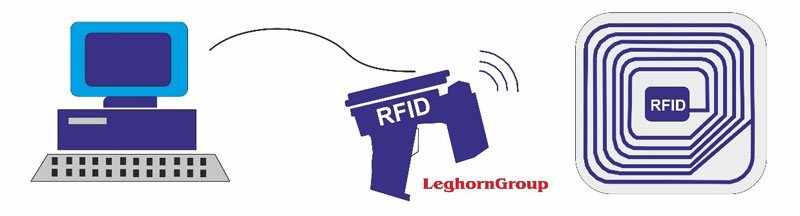
Identification is carried out using an antenna that reads a chip—called a tag or transponder—applied to the object (or person or vehicle) being identified. The tag stores a certain amount of information about the item, such as an identification code, manufacturing date, or manufacturer. This data may be fixed or updated over time.

The tag does not require its own power source to operate. When it is exposed to the magnetic field generated by the antenna, it captures and stores a small amount of energy, which it then uses to transmit its data over a short distance. This type of tag is known as a passive tag.

When a passive tag enters the operating field of a reader—ranging from a few centimeters to several meters—it is “activated” by the electromagnetic field produced by the reader. The tag responds by reflecting back a modulated signal containing its stored information.

The reader receives and decodes this modulated signal to identify the tag. Passive tags are the most widely used on the market, primarily due to their low cost, which makes them suitable for a wide range of applications.

ACTIVE RFID
How it works technically

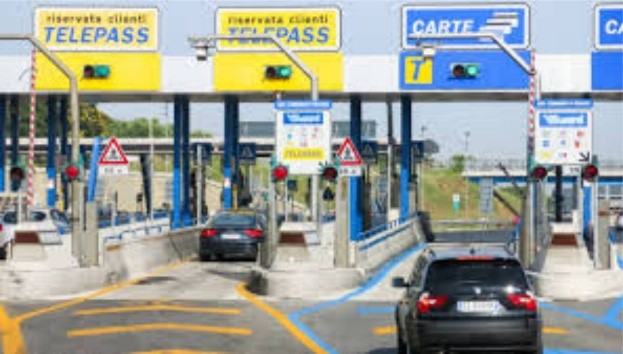
Telepass is an example of an application that uses an active RFID transponder.

When long-range transmission is required, higher power is needed, and the tag must be supplied with its own power source, such as a battery. In this case, the tag is referred to as an active tag.

RFID technology can be applied across a wide range of sectors. Its use is rapidly expanding in industrial manufacturing, logistics, and the apparel industry, as well as in healthcare, public administration, access control, and many other fields.

RFID technology, and applications in logistics.

What are the frequencies used in RFID?

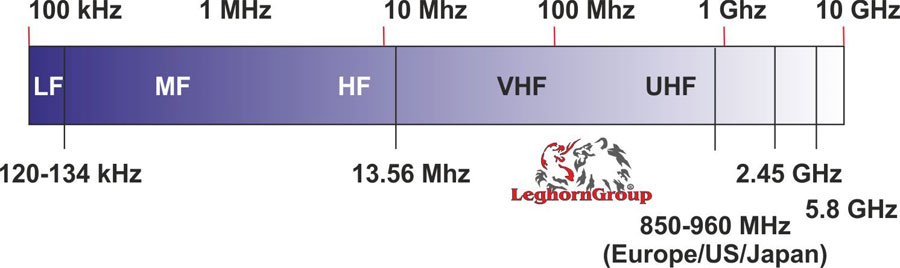
RFID systems use various frequencies, which can be classified as:

– low frequencies (LF, between 125 and 134 kHz)
– high frequencies (HF, around 13 MHz)
– very high frequencies (UHF, between 860 and 960 MHz)
– microwave (over 2.45 GHz)
RFID technology, and applications in logistics.

In general, as frequency increases, both the reading distance and the amount of data that can be transmitted per unit of time increase, while resistance to harsh operating conditions improves less and costs tend to rise.

Low-frequency (LF) tags consume very little power and can pass through non-metallic materials and liquids, but their reading range is limited to about 30–40 cm.

High-frequency (HF) tags perform well around metal objects and typically offer a reading distance of up to about one meter.

Ultra-high-frequency (UHF) tags provide much longer read ranges and faster data transfer, but they do not penetrate materials easily.

Solutions based on 2.45 GHz tags are commonly used in applications such as Telepass and similar systems.